
A Business Growth Assessment helps businesses identify the strategic, operational, technological, and financial challenges that may be limiting their growth. Through its Fractional Chief Business Officer (CBO) services, Suseebiz provides senior-level business leadership to evaluate growth barriers, align business strategy with operations, and develop an actionable roadmap for sustainable, measurable growth.
A Business Growth Assessment provides leadership with a structured view of the organization to identify the barriers that may be limiting growth and determine where to focus first. The objective is to understand where the business is today, identify the highest-priority opportunities, and establish a practical path toward measurable growth. Through its Fractional CBO role, Suseebiz helps translate these priorities into an actionable growth roadmap with clear ownership, KPIs, and disciplined execution.
Growth Problems Are Not Always Sales Problems
When growth slows, businesses often respond by increasing sales and marketing activity: more campaigns, more leads, more outreach, and more advertising. But generating additional demand may not address the real constraint.
A business may already be attracting customers but losing opportunities because its sales process is inconsistent. Operations may struggle to handle additional demand. The value proposition may be unclear, technology systems may not be integrated, or management may not have visibility into the right KPIs. Sustainable growth requires more than increased activity; it requires alignment across the business.
What Is a Business Growth Assessment?
A Business Growth Assessment examines the factors influencing an organization’s ability to grow. Depending on the business, it may evaluate:
- Current business position and growth objectives
- Market opportunities, customers, and competitive positioning
- Strategy and organizational alignment
- Sales and customer acquisition challenges
- Operational constraints and process inefficiencies
- Technology capabilities and digital readiness
- Financial considerations and resource priorities
- KPI visibility, performance management, and execution
The assessment creates a clearer picture of the business before significant investments, technology decisions, expansion initiatives, or growth programs are undertaken.
Five Critical Areas of a Business Growth Assessment
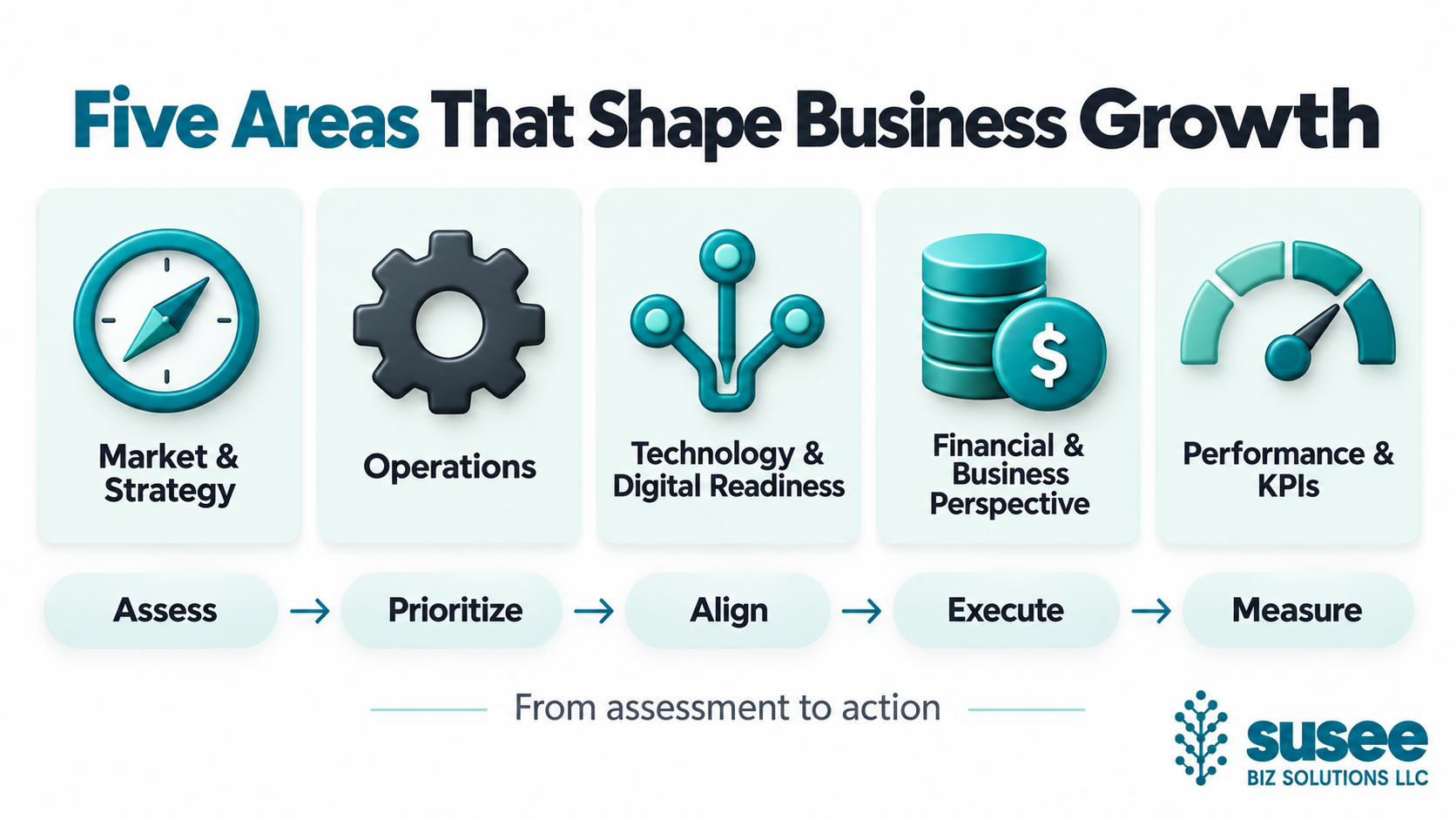
1. Market and Strategy
Who is the ideal customer? Which segments provide the strongest opportunities? Is the value proposition clear and differentiated? Does the organization have a defined growth direction, and are leadership and teams aligned around the same priorities?
2. Operations
Can the organization efficiently handle additional demand? Are processes scalable? Where are the bottlenecks, delays, or unnecessary manual activities? Increasing sales without addressing operational constraints can simply create larger problems.
3. Technology and Digital Readiness
Do current systems support the company’s growth objectives? Are they integrated, and is important information readily available? Technology—including automation, data analytics, AI, and immersive technologies—should address defined business needs rather than become a collection of disconnected tools.
4. Financial and Business Perspective
Growth decisions have financial implications. Investment priorities, resource allocation, financial performance, and potential contribution to business value should be considered alongside operational and technology requirements.
5. Performance and KPIs
Is the organization tracking the measures that matter? Leadership should be able to identify what is working, detect emerging problems, measure progress against strategic objectives, and take corrective action. Effective KPIs connect strategy with measurable execution.
Prioritize Before Adding More
One of the biggest risks for a growing business is trying to improve everything at once. The most visible problem is not necessarily the most important one. Improving a core sales process may deliver more value than launching another marketing campaign. Removing an operational bottleneck may have greater impact than purchasing another technology platform.
A useful assessment therefore helps leadership answer four practical questions: What should we do first? What comes next? What should we measure? Who owns the action? The answers can then be translated into immediate, near-term, and longer-term initiatives with clear ownership and measurable outcomes.
When Is a Business Growth Assessment Useful?
An assessment can be particularly valuable when revenue growth has slowed, the company is entering a new market, sales and marketing are not producing expected results, operations are difficult to scale, technology investments are increasing without clear outcomes, KPIs are unclear, or multiple initiatives are competing for limited resources. It can also provide clarity before a major expansion or transformation initiative.
Why Suseebiz?
Business growth challenges rarely exist in isolation. Addressing one functional area without understanding its relationship to the rest of the organization can leave the underlying constraint unresolved.
The Suseebiz leadership team brings decades of business and industry experience, including extensive experience across manufacturing, technology, and business management. This provides a 360-degree perspective that connects strategy with the realities of operations and execution.
Our experience encompasses manufacturing processes and operations, business strategy and management, technology, Balanced Scorecard methodology, KPI and performance management, business finance, business valuation, and organizational execution. This breadth enables us to examine how decisions in one area can affect customers, operations, technology, finance, people, and overall business performance.
Our Differentiators
360-Degree Business Perspective
Suseebiz does not evaluate growth through a single functional lens. We consider market opportunities, strategy, manufacturing and operational processes, technology, digital readiness, financial considerations, performance measures, and organizational execution as interconnected parts of the business.
Strategy + Operations + Technology
Technology should support business objectives. We begin with the business need and then evaluate where technology, AI, automation, data analytics, immersive technologies, or other digital capabilities can create practical value.
Balanced Scorecard and KPI-Driven Execution
The Balanced Scorecard framework helps organizations connect strategic objectives with measurable performance indicators. Strategy becomes meaningful when it is translated into measurable objectives. Balanced Scorecard thinking and KPI management help connect strategic priorities with operational execution, accountability, and results.
Business and Financial Perspective
Our assessment also considers investment priorities, resource allocation, financial performance, and business value. This helps leadership evaluate initiatives not only for operational or technology benefits but also for their contribution to the broader business.
From Assessment to Action
The objective is not to produce another report that sits on a shelf. Findings should lead to an actionable growth roadmap with prioritized initiatives, clear ownership, and measurable KPIs.
The Suseebiz Approach
Our approach can be summarized in five steps:
Assess → Prioritize → Align → Execute → Measure
We help leadership understand where the business is today, where it wants to go, what may be preventing progress, what should be done next, and how results will be measured.
Sustainable growth is not simply about doing more. It is about doing the right things, in the right sequence, with measurable results.
What Is Holding Back Your Next Stage of Growth?
If your organization has growth opportunities but you are not certain where to focus first, a structured Business Growth Assessment can help establish the priorities.
Request a Business Growth Assessment discussion with Suseebiz to explore your current challenges, identify potential growth barriers, and determine practical next steps.